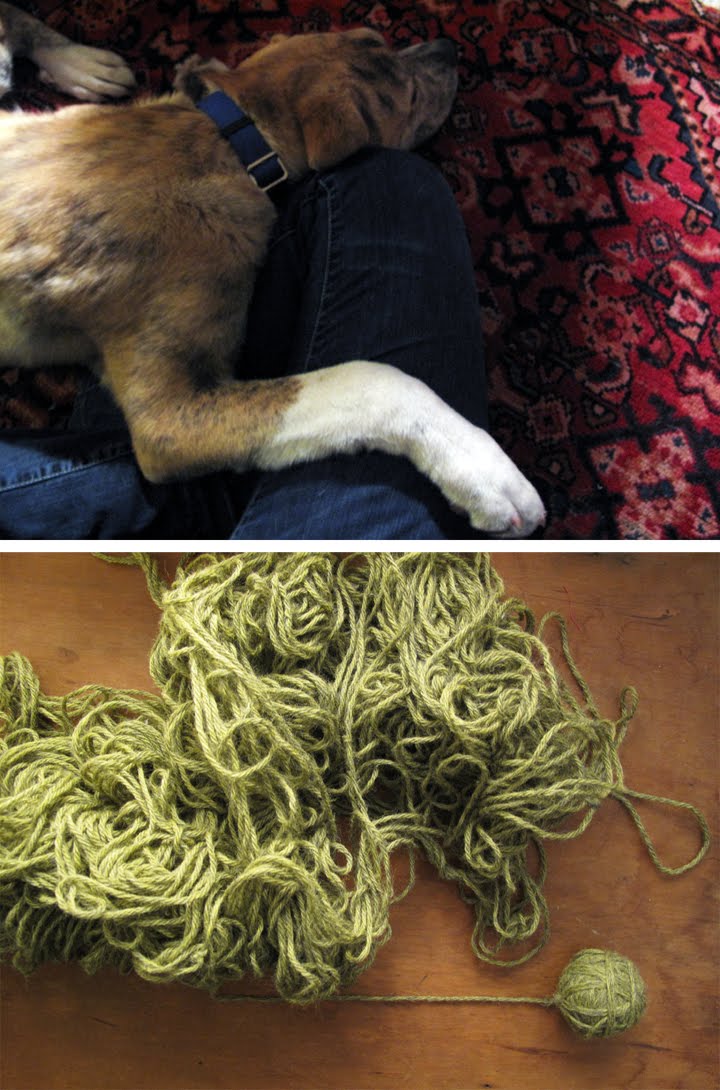
When I asked for a "picolo" gelato for my son, the so (so!) handsome Italian owner of this gelato shop in Soho gave us a tiny vanilla cone gratis. He had wavy silver hair and wore a starched pinstripe shirt. I almost felt at home.
Tuesday, May 25, 2010
Bowls and bunnies and curios.
Fields of felt.
Shootout at Purl.
Sunday, May 16, 2010
One of my work tables this morning. Its order surprised me. I have been knee deep in roving and paperwork and finally cleared the studio and dealt with things undealt with since March.
The blue doll form is a prototype - I could aim for proficiency as a seamstress, but I will instead aim for charm and maintain my grade school skill set.
Mary Ann Holmes of H & K Farms in Pleasureville, KY spun the skein of Icelandic wool. I am going to make mittens with it and then sit on our front porch and wait for winter.
The bowl is full of antique rag yarn purchased on Etsy and a tiny rag doll from Scottsburgh, Indiana.
The frame holds a 1920s advertisement.
My grandmother
Alberta Regina Miller
- Mom-Mom -
models the yarn.
At the Kentucky Sheep and Fiber Festival today: serious mittens and a lamb reaching for greener pastures. There was a perpetual spray of rain in the air, a bagpiper out in the field and Russian Wolfhounds loping about.
These mittens were knitted and fulled by Debbie Barnett - I think she said she was from Bourbon Co., KY. They are her father's - he wears them to feed the cows. I would love a pair for walking Puppy on cold nights.
This lamb belongs to Diane MacDonald of Tanglewood Farm. A bag of her green citrus roving called to me, but I opted instead for some of her black and orange roving. I hope to spin it into an autumn hat for my son.
My good friends JoAnn Adams http://www.sweet-home-spun.com and Angela Mobley http://theartistthemom.blogspot.com were at the festival - I lured many friends to their kind and knowledgeable webs.
A poem:
wolfhounds loping about
cold nights
for my son
knowledgeable webs
These mittens were knitted and fulled by Debbie Barnett - I think she said she was from Bourbon Co., KY. They are her father's - he wears them to feed the cows. I would love a pair for walking Puppy on cold nights.
This lamb belongs to Diane MacDonald of Tanglewood Farm. A bag of her green citrus roving called to me, but I opted instead for some of her black and orange roving. I hope to spin it into an autumn hat for my son.
My good friends JoAnn Adams http://www.sweet-home-spun.com and Angela Mobley http://theartistthemom.blogspot.com were at the festival - I lured many friends to their kind and knowledgeable webs.
A poem:
wolfhounds loping about
cold nights
for my son
knowledgeable webs
Monday, May 10, 2010
Saturday, April 24, 2010
Sunday, April 18, 2010
Wednesday, April 14, 2010
Sunday, April 4, 2010
Our mint is up.
Neil has begun the bed for the herb garden. A bed for plants. Plant bedding. Garden shams and dirt ruffles. Grass blankets. Pillow moss. House yellow and sky blue. Oh, it is so nice to have a back yard. In New York in early spring, I would open a window, stick out my head, close my eyes and pretend that I was not in the city. The city matters, but it is also good to look at a tree, feel the grass and not hear any traffic.
Tuesday, March 30, 2010
Play is a dirty word.
From 1995 to 1998, west coast photographer John Divola worked on a series of photographs of isolated houses in the desert in the Morongo Valley in Southern California. In his introduction to Dogs Chasing My Car in the Desert he writes, “As I meandered through the desert, a dog would occasionally chase my car . . . .Sometime in 1996 I began to bring along a 35mm camera . . .” Of the artwork for which he is now internationally recognized, David Shrigley said: “I didn't think of my drawings as Fine Art until quite a long time after art school. . .” As Shrigley found application for his drawing style in the established fine art domain, John Waters broke from the popular medium of movies to the gallery setting with “Director’s Cut,” a collection of “re-directions” or “little movies,” photographs taken of films as they played on his television screen, which he then reworked into shortened footage rife with his own commentary. Divola’s photographs of dogs were taken on the way to his scheduled shoots; Shrigley did not initially consider his drawings publishable. Waters’s “re-directions” were pet projects devoted to a private interaction with pre-existing film imagery: “I took my ‘little movie’ photographs for years without telling anybody.”
The projects referenced here, Dogs Chasing My Car in the Desert, The Book of Shrigley, and Director’s Cut, could be said to amount to no more than photos of dogs, doodling and a re-mixing of antiquated movies. Yet the works yield insights into the nature of our existence and the rituals we employ to engage with and interpret our world, be it immediate, assimilated, or simulated. Divola, Shrigley and Waters articulate varying degrees of self-consciousness within the act of observation, of seeing, of visual communication not simply between artist and art viewer, but between the artist and his subject. Waters confesses, “I never watch a movie I love a second time around because I’m always afraid I’ll be disappointed.” Shrigley says, “I have always kept a notebook to make drawings in ever since I was a child. I never really thought of it as art, it was more like keeping a diary.” Divola writes: “Contemplating a dog chasing a car invites any number of metaphors and juxtapositions: culture and nature, the domestic and the wild, love and hate, joy and fear, the heroic and the idiotic.”
The self-awareness that each artist attaches to his project is held in check by a force of spontaneity engendered by an engagement with a living other, an intuitive process, or the development of a virtual field. Dogs Chasing My Car in the Desert, The Book of Shrigley, and Director’s Cut embody forms of play: abandon, absurdity, irreverence, wickedness, wantonness, feral-ness. While depicting playfulness, they also constitute in and of themselves playful acts.
In the case of each of the three artists whose work is mentioned here, none considered these particular projects central to their focus at the time of their inception. These were peripheral projects, ancillaries to intended projects, to the work “at hand”.
Sunday, March 28, 2010
Monday, March 22, 2010
The concert supported the Benefit Artists Welfare Fund and was attended by an audience open to contemporary art and the avant-garde. Yet the audience did not share Cage’s willingness to engage a moment, a short passage of time, with a minimum of intention. As Cage explained, "The essential meaning of silence is the giving up of intention." Cage operated within the convention of a concert setting, but opened the moment to chance. Of his experiments with the I Ching he said,
If you use, as I do, chance operations, you don’t have control except in the way of designing the questions which you ask. That you can control. I mean you can decide to ask certain questions and not others. But if you use chance operations, you have no control over the answers, except the limits within which they operate.
In explaining the audience’s discomfort with 4’33”, Peter Gutman alludes to a basic human need for “the familiarity of repetition.” Cage inverted the familiar setting of a classical concert by introducing a seeming silence where the audience expected orchestrated sound. In fact, Cage did not consider 4’33” silent. Rather, his composition argued against the very existence of silence. In 1951 he had entered an anechoic chamber to experience the complete absence of noise only to discover the resonant sound of his own nervous and circulatory systems: “Try as we may to make silence, we cannot.”
Sunday, March 14, 2010
Subscribe to:
Posts (Atom)